Section 13 - Writing
Pencil and paper can be very useful for those situations where the speaker just can’t be understood. Using the written word can be helpful in all sorts of situations such as at the train station, when out shopping, meetings and consultations, and also in social setting.
Below are some comments that people made about using writing as a conversation strategy:
1. I take pen/pencil and paper with me wherever I go. If I cannot follow a person I give them the pen and paper to write it down for me.
2. If I am making arrangements with someone or if they give me information I write it down. Then if I am unsure I can ask them to check I’ve got it right. (See also Chapter 1, Section 20: "Checking")
3. I always write down the details about a meeting place, etc. and then I get the speaker to check. This helps me to avoid confusion. (See also Chapter 1, Section 20: "Checking")
4. If someone tells me a time (e.g. to meet them) I get them to write it down. This makes sure I have lipread the time correctly.
5. I find people’s names and place names very difficult to hear/lipread. I always carry a pen and some paper so I can ask people to write these down.
6. If someone is writing notes for me I ask them to write it down in full. This means I don’t have to guess what their abbreviations mean.
7. Someone recently bought me a Boogie Board for a present - I find it really useful as people can just jot down whatever it is I am struggling with and it's small enough to fit in my handbag.
(Editor's note: A Boogie Board is an LCD e-writer - no that didn't mean anything to me, either! - but Hearing Link has a good explanation of Boogie Boards in their online shop and it seems they do the same job as paper and pen without wasting paper. You can get Boogie Boards elswhere, too. It pays to shop around for prices.)
Sudden deafness and the written word
People who have experienced sudden severe or profound deafness have found the written word invaluable. In this situation getting people to write things down can be a lifeline.
One person who experienced a sudden profound hearing loss said, “If people hadn’t been prepared to write things down for me in those first few months, I wouldn’t have been able to cope at all. I found that once I explained that unless they wrote down I would not be able to understand them people were more than willing to help. As my lipreading improved people didn’t have to write quite so much. Even now, after several years, I take pen and paper everywhere with me for those difficult situations”
________________________________________________________________________________
Section 14 - Fingerspelling
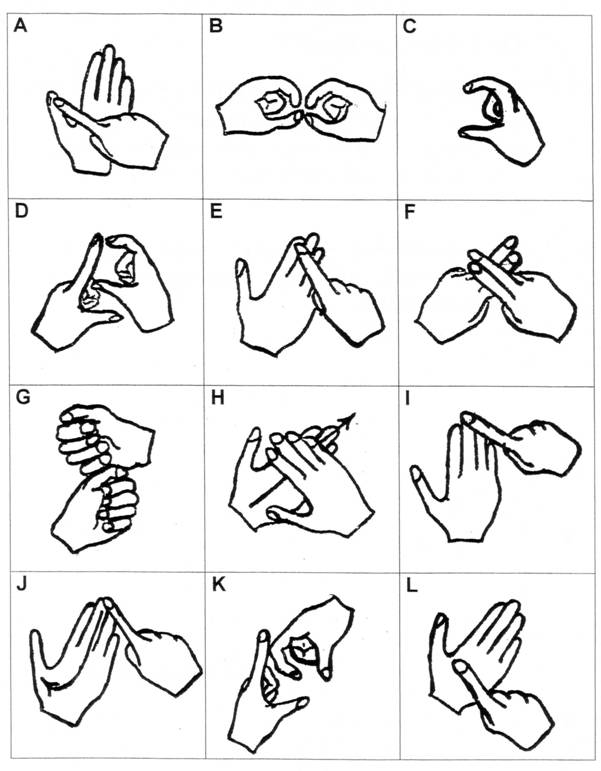
Fingerspelling is a manual alphabet which in which different shapes of the hands and fingers are used to show the alphabet.
Many deaf people said that they had found fingerspelling a useful tool. It does, of course, depend on other people knowing how to do it and the deaf person learning how to read it!
Here is an example:
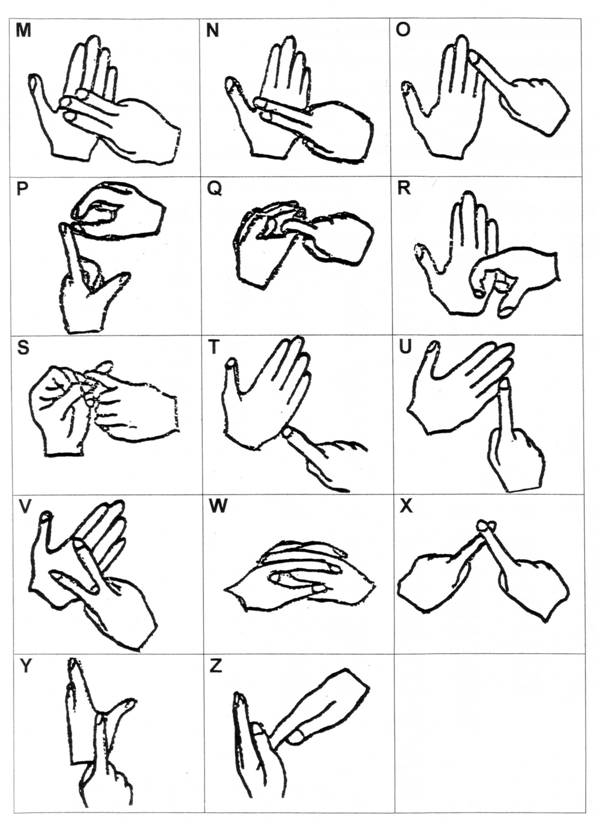
This chart was designed by Henesy HouseThere are other fingerspelling charts on various websites that can be printed off to give to friends or relatives to encourage them to learn it.
These are some of the websites that have fingerspelling charts and other information about fingerspelling:
left-handed fingerspelling chart
right-handed fingerspelling chart
www.jimcromwell.com/BSL/spell.htm
1. Some people said they had encouraged their friends and relatives to learn fingerspelling, which they found very helpful.
2. I learnt fingerspelling a few years ago. I found it easier to do the fingerspelling than to read it back when someone did it for me, but now that I’ve mastered it, I find it very helpful and have taught it to my husband too.
3. I ask people to fingerspell the first letter or first 2 or 3 letters of names and any words which I can’t lipread or hear: I also ask people to fingerspell words which look the same or similar; for example, if I’m not sure if they’ve said view or few, I ask them to fingerspell it to me. Some family members and some friends know fingerspelling and it is a wonderful help.
4. With words that begin with sounds like sh, ch, j, str, st, etc, I ask people to fingerspell the first few letters.
5. Fingerspelling and the lipreading class: I learnt fingerspelling at my lipreading class. I find it helps me to communicate better with the other members of the lipreading class who use it.
6. Fingerspelling with members of the deaf community: I like fingerspelling because it helps me communicate with the deaf community which uses sign language.
7. Fingerspelling and grandchildren: Fingerspelling is a point of contact with my grandchildren who have learnt it at school and enjoy using it with me.
Another person said: I have taught my grandchildren to fingerspell and they really enjoy learning it and using it with me. It has also made them much more aware of my needs and they often now communicate better than their parents.
8. I learnt to fingerspell at my lipreading class and I taught it to my husband. We’re now quite good at it and we’ve found it very useful as it’s quicker than hunting for pen and paper and writing it down when I get stuck on a word.
________________________________________________________________________________
Section 15 - Sign Language
Sign language is a way of communicating visually using facial expressions, lip movements, gestures and body language. Some people with an acquired hearing loss have found it useful to learn sign language with a friend or family members.
British Sign Language (BSL)
British Sign Language is a language in its own right. BSL is the language used by the Deaf Community in the UK. It has its own grammar and syntax, which are completely different from the grammatical rules of English.
Sign Supported English (SSE)
Sign Supported English uses the signs from BSL, but in spoken English grammar structure. SSE may be used by people with acquired deafness who have English as their first language.
Some websites where you can learn more about sign language:
www.deafsign.com
http://www.opencollege-signlanguage.co.uk/for information on where to learn sign language:
www.signature.org.uk/________________________________________________________________________________
Section 16 - Alternative methods of communication
There are various alternative methods of communication for deaf people besides lipreading and sign language.
a.Cued speech
Cued Speech is a phonetic system which uses eight handshapes in four different positions in combination with the natural lip-patterns of speech. It is more often used with young deaf children, but is sometimes used with deafened adults. It can allow experienced users to gain up to 96% of what is being said rather than the 30-40% when using lipreading alone.
For more information on Cued Speech see the following websites:
www.cuedspeech.org/
http://www.cuedspeech.co.uk/b. Paget-Gorman signed speech
This is a manually coded form of the English language, designed to be used with people with speech or communication difficulties. It has a limited vocabulary and is not based on the signs used in the deaf community.
For more information on Paget-Gorman signed speech see the website:
http://www.pagetgorman.orgc. Makaton
Makaton is a system of communication that uses a vocabulary of manual signs and gestures and graphic symbols to support speech. It is mostly used with children, but is sometimes used with adults.
For more information on Makaton see the website:
http://www.makaton.org/
deaf strategies website


subglobal1 link | subglobal1 link | subglobal1 link | subglobal1 link | subglobal1 link | subglobal1 link | subglobal1 link
subglobal2 link | subglobal2 link | subglobal2 link | subglobal2 link | subglobal2 link | subglobal2 link | subglobal2 link
subglobal3 link | subglobal3 link | subglobal3 link | subglobal3 link | subglobal3 link | subglobal3 link | subglobal3 link
subglobal4 link | subglobal4 link | subglobal4 link | subglobal4 link | subglobal4 link | subglobal4 link | subglobal4 link
subglobal5 link | subglobal5 link | subglobal5 link | subglobal5 link | subglobal5 link | subglobal5 link | subglobal5 link
subglobal6 link | subglobal6 link | subglobal6 link | subglobal6 link | subglobal6 link | subglobal6 link | subglobal6 link